
Marketing Strategy Plan: Conscious Climber
- Jenna Cardamone
- Jul 19, 2023
- 10 min read

Updated: Jul 22, 2023

Introduction:
The Conscious Climber is a brand that aims to address fear in the climbing world by using encouraging and empowering words to motivate the way climbers think, feel and act. The Conscious Climber stands for the inner strengths developed in climbing, and their brand reflects this both through the colors and words chosen for their products. These brand qualities stood out and encouraged myself to connect with Catherine and her company. After analyzing The Conscious Climber and researching areas to enhance the brand further, I wanted the marketing plan to highlight what the brand stands for and what drew myself to the company. Below you will find research, resources, and recommendations to make The Conscious Climber the ultimate brand.
Identifying Customers:
Demographics-
The customer demographic would involve primary about 70% females and 30% males They are athletic, healthy, and financially sustainable. They are adults aged 18-35.
Geographics-
Being a Canadian brand that is mostly sold in MEC stores in the West of Canada, the geographics of The Conscious Climber would have to be in the provinces of Alberta and British Columbia. The Conscious Climber also has an E-commerce store which broadens the range to any prevalent rock-climbing area or Mountain range in North America.
Psychographics-
The psychographics of a customer for The Conscious Climber is outgoing and adventurous. They are easy-going people. They will have more of a liberal attitude when it comes to change, or other people's opinions but will have opinions of their own. They will not force you to join their lifestyle, but highly encourage it. Their lifestyle and interests consist of being outdoors, trying new things, rock climbing, meditation, and more extreme or out of ordinary hobbies/interests.
Action Plan:
When determining what I could do to help Catherine, I decided to focus on distribution and on ads and copy.
My objective for distribution was to explore what the processes are to setting up and running an Amazon distribution channel. It will allow Catherine to seamlessly transfer the purchasing process online from the current platform and requires virtually no maintenance. I planned to run this distribution channel through thorough research of best practices when using an Amazon distribution channel, and by actually creating a potential distribution path for the products. I planned to take note of how hands on the process is, and how much time it requires regularly to function.
My objective for ads and copy was to be primarily focused around creating printed posters, rather than digital content. These posters are to be utilized in spaces such as gyms, climbing stores, and other related areas. The color palette that was planned to be used throughout these prints was earth tones. It was my goal to create ads for both products and the brand itself separately, to avoid an information overload on consumers. I planned on researching local influencers on social media, and how they may be an additional way to get Conscious Climbers to an untapped audience. I planned for the physical ads to include a digital element of a QR code. The QR code would take you to a landing page that will have all of the information that the consumer is looking for.
Results for Distribution:
After analyzing The Conscious Climber’s distribution methods, I concluded that there were more opportunities to sell Catherine’s products through additional distribution channels. The reason it is important to explore more distribution channels, is that there is a greater opportunity for customers to come across the product and decide to buy it. With more than one channel, it can also provide more consistent revenue. It is important to create accessibility to the product through e-commerce because many customers may not be located geographically close to a store that physically sells them, they may not feel comfortable in person shopping due to the pandemic, or may not be able to be made aware of the product if it is only sold in a few places. E-commerce distribution methods also provide Catherine with an easier way to track current sales, handle product storage, and receive payments directly.
When researching distribution methods, I began looking into Amazon. I first researched its best practices and then the process to set up a distribution channel through Amazon. Here are the results:
Best Practices When Using/ Keep in Mind for Amazon-
· The first three months after someone launches an Amazon business is a valuable time for establishing practices that will boost your performance from there on out.
· To sell branded products protected by copyright, trademark, or patent, someone must be the legal owner of the brand or an authorized reseller.
· Amazon will only allow someone to sell any type of accessory in new conditions, no exception.
· Every product offered for sale on Amazon gets an automatically generated ASIN (Amazon Standard Identification Number), which is different from a GTIN or SKU. Multiple sellers may offer the same ASIN.
· When multiple sellers offer the same product, Amazon combines data from those various offers on a single detail page. Sellers who offer the product can contribute detail page information—or request detail page reviews if the information displayed is incorrect.
· If someone sells their products under a registered trademark, consider enrolling in Amazon Brand Registry, a free service that gives them an increased control over product detail pages that use their brand name.
· If more than one seller offers a product, they may compete for the featured offer (“Buy Box”), the most visible offers on the product detail page. Sellers must meet performance-based requirements to be eligible for Featured Offer placement.
· When someone signs up to sell on Amazon, they are automatically enrolled in FBA (Fulfillment by Amazon) for free. If they decide to go that route, they will send inventory to Amazon fulfilment centers, and Amazon will handle shipping, customer service, refunds, and returns for those products. They can track your FBA inventory in Seller Central. Fees can apply. There is no minimum number of units and no obligation to use FBA for all their products.
Process To Set Up for Amazon-
First, Catherine must begin setting up her warehouse and distribution channels. She must first register a seller account on Amazon. They have two plans to purchase. The first is the Individual Plan that requires you to pay a $1.49 CDN per item sold fee. This plan is ideal for you, if you sell fewer than 30 items a month, you do not need advanced selling tools or programs, or if you are still deciding what to sell. The second is the Professional Plan that requires you to pay $29.99/month CDN, plus seller's fees that vary on the product. There is no per item sold fee for this plan. This plan is ideal for you, if you sell more than 30 items a month, you want access to APIs and more selling reports, or if you are wanting to sell with programs like Launchpad or Handmade.
Before Catherine signs up, she must make sure shes ready with the following:
Business email address or Amazon customer account.
Chargeable credit card.
Government ID (identity verification protects sellers and customers).
Tax information.
Phone number.
A bank account where Amazon can send you proceeds from your sales.
Second, Catherine must build a distribution network. Start off by carefully considering your customers and their needs. Do they want to have fast shipping (fees can apply), international delivery, for you to advertise your offers, or to have competitive prices?
Third, Catherine can now create product listing details. To start selling a product on Amazon, she will need to create a product listing in Seller Central (or via API). A product listing includes:
A product identifier, such as GTIN, UPC, ISBN, or EAN to specify the exact item you are selling. You can get a UPC code directly from GS1 or request an exemption.
A SKU, which is a product ID you create to track your own inventory.
Offer details, including price, product condition, available quantity, and shipping options.
Product details like name, brand, category, description, and images.
Keywords and search terms to help customers find your product.
If another seller already offers the same product, you’ll match an existing listing (which means some details will already be in place, like the product identifier). If you’re the first seller to offer a product, you’ll create a new listing.
To create a product listing page, she will need to fill out and consider a few requirements. For your title, consider using only 200 characters max and capitalizing the first letter of every word. For images, consider 500 x 500 or 1,000 x 1,000 pixels to increase listing quality. Consider emphasizing the variations of colours and meaning of your products. Utilizing bullet points and keywords in your description allows it to be short and descriptive highlighting key features and benefits. Consider using the featured offer “Buy Box”, which is an offer featured on a detailed page about your product with a button for customers to add directly to their cart or “Buy Now.”
Fourth, and finally, Catherine can now track her results and perform distribution network optimization. Seller Central is a website where sellers log in to monitor their Amazon sales activity. You can manage inventory, update pricing, communicate with buyers, review account health, contact selling partner support, and add new products. Use the Amazon Seller app to track sales, fulfill orders, find products to sell, respond to customer questions, capture, and edit professional-quality product photos, and create listings—all from your phone.
Results for Ads and Copy:
Print Ads-
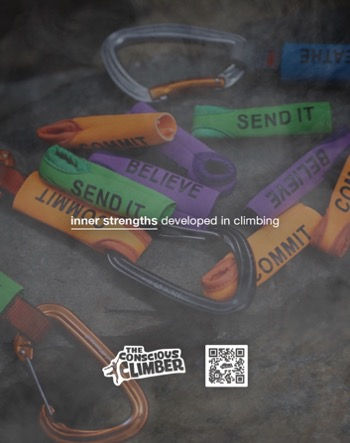
One key feature I wanted to utilize within the posters is a QR code, as this is an easy and effective way to drive viewers to a specified location, in this case a landing page directing to either the Conscious Climber website or official Instagram. With the first two posters, a more serious approach was used, taking inspiration from brands such as Arc’teryx. Using one of Conscious Climbers mantras from the website, it is completed by a minimal looking logo and QR code at the bottom of the poster. The next poster is created in a collection of the current six products on the website (Only one colour example shown). Each poster is unique in color and features a different trail from the bottom of the poster up to the top where a QR code is placed beside the trail end. Also along the trail is Conscious Climber’s climber logo attempting to navigate each trail. These six posters are created with the thought of inclusion and encouragement, as the bright colors and fun appearance bring in younger eyes who may be new in the climbing world and are looking for that extra word of encouragement. The paint splatters are to signify the fun aura of the Conscious Climber brand.

If these posters were to be printed, they would work best on 11x14 inch sized paper. When posting to social media, posting one every three or four posts while adding your other content between would do well in attracting the average eye to your feed. When posting every three posts, it creates a vertical appearance in your feed, and posting every four creates a diamond appearance. These strategies are simple but enough to give your feed a unique appearance. As for captions, adding a mantra of your choosing relating to the product in the post is a great way to get your point across on why that word means something to you. Be sure to use hashtags as well in a separate comment or a few lines below your main caption. The hashtags currently used have a good grasp of what you should be targeting. Don’t be afraid to touch both broad and niche hashtags.

QR Codes-
The benefits of a simple to use system for promoting your brand are huge. The increasing use of QR codes in society comes with good reasons. QR codes are simple to use tools that can be scanned by any modern smartphone, taking the individual to a predetermined webpage. In Catherine's case, the QR code will take the interested individual to a landing page where they can receive more information on the social media pages of Conscious Climber, as well as where to buy the products. The reasoning for the success of QR codes as a marketing tool over the past several years can be attributed closely to the rise in smartphone technology. Every modern smartphone will have an integrated QR code reader in their native camera app, alongside many social media platforms having the same things built into their UI. This means there are an abundance of ways to utilize the technology, and it can be easily shared on social media with posts/additional sharing.
Below is an image of the landing page you will see when the QR Code is scanned.

This is a simple example of the landing page offered through the QR code software chosen. As you can see it offers a collection of useful links for customers to find the products as well as following social media and other relevant links. The landing page can also be further customized with new links and a custom photo at the top for increased flexibility.
Conclusion:
The lack of ads and copy and distribution methods have hindered the ability to spread The Conscious Climbers message and products to potential clients. By utilizing the research and applying it to the daily business needs of Catherines company, she will be able to reach more potential clients, and sell her product with ease. I recommend Catherine to utilize Amazon distribution methods to allow her product to have a greater reach and alleviate the stresses of selling without a distribution method. I also recommend that going forward, Catherine utilizes the QR Code on the print ads made above and future ones she creates in other colours. This will allow the ads to highlight the product and ensure that her ads are clean, while still containing lots of information for the customer.
References:
About Instagram's official site. Instagram. (n.d.). Retrieved March 28, 2022, from https://about.instagram.com/
About the author Michael Keenan Michael is a SaaS Marketer and SEO and founder of Peak Freelance. He’s inspired by learning people’s stories. (2021, June 27). It's your time to shine: How to find and work with Instagram influencers in 2021. Shopify. Retrieved March 28, 2022, from https://www.shopify.ca/blog/instagram-influencer-marketing
Adobe Photoshop CS. (2022). Berkeley, CA: Peachpit Press.
Become an amazon seller: How to sell on amazon.ca. Become an Amazon Seller | How to Sell on Amazon.ca. (n.d.). Retrieved March 1, 2022, from https://sell.amazon.ca/sell?ref_=sdca_soa_hp_sell
Beginner's Guide to selling on Amazon: How to guide. Beginner's Guide to Selling on Amazon | How To Guide. (n.d.). Retrieved March 1, 2022, from https://sell.amazon.ca/beginners-guide?ref_=sdca_soa_tbg_n
Create your ecommerce store with shopify. Shopify. (n.d.). Retrieved March 2, 2022, from https://www.shopify.ca/free-trial/ecommerce
Grow your Amazon Selling Business: Advertising, Brand Services, global selling, and more. Grow Your Amazon Selling Business | Advertising, Brand Services, Global Selling, and More. (n.d.). Retrieved March 1, 2022, from https://sell.amazon.ca/grow
How much does it cost to sell on Amazon? How Much Does it Cost to Sell on Amazon? (n.d.). Retrieved March 1, 2022, from https://sell.amazon.ca/pricing?ref_=sdca_soa_hp_pricing
How to promote your Instagram: 13 ways that actually work. Sprout Social. (2021, September 20). Retrieved March 28, 2022, from https://sproutsocial.com/insights/promote-your-instagram/
Shipping and fulfilment by Amazon for Amazon Sellers. Sell on Amazon.ca. (n.d.). Retrieved March 1, 2022, from https://sell.amazon.ca/fulfill?ref_=sdca_soa_hp_fulfill
Shopify pricing - setup and open your online store today – free trial. Shopify. (n.d.). Retrieved March 12, 2022, from https://www.shopify.ca/pricing
The QR code generator. The QR Code Generator. (n.d.). Retrieved March 28, 2022, from https://www.the-qrcode-generator.com/
Twitter. (n.d.). Twitter. Retrieved March 28, 2022, from https://twitter.com/?lang=en
Zolee, & Zolee. (2018, January 22). 6 red watercolor splatter (PNG transparent). OnlyGFX.com. Retrieved March 21, 2022, from https://www.onlygfx.com/6-red-watercolor-splatter-png-transparent/


Comments